Whitepapers
Enterprise digital signage in 2026: a market analysis for partners
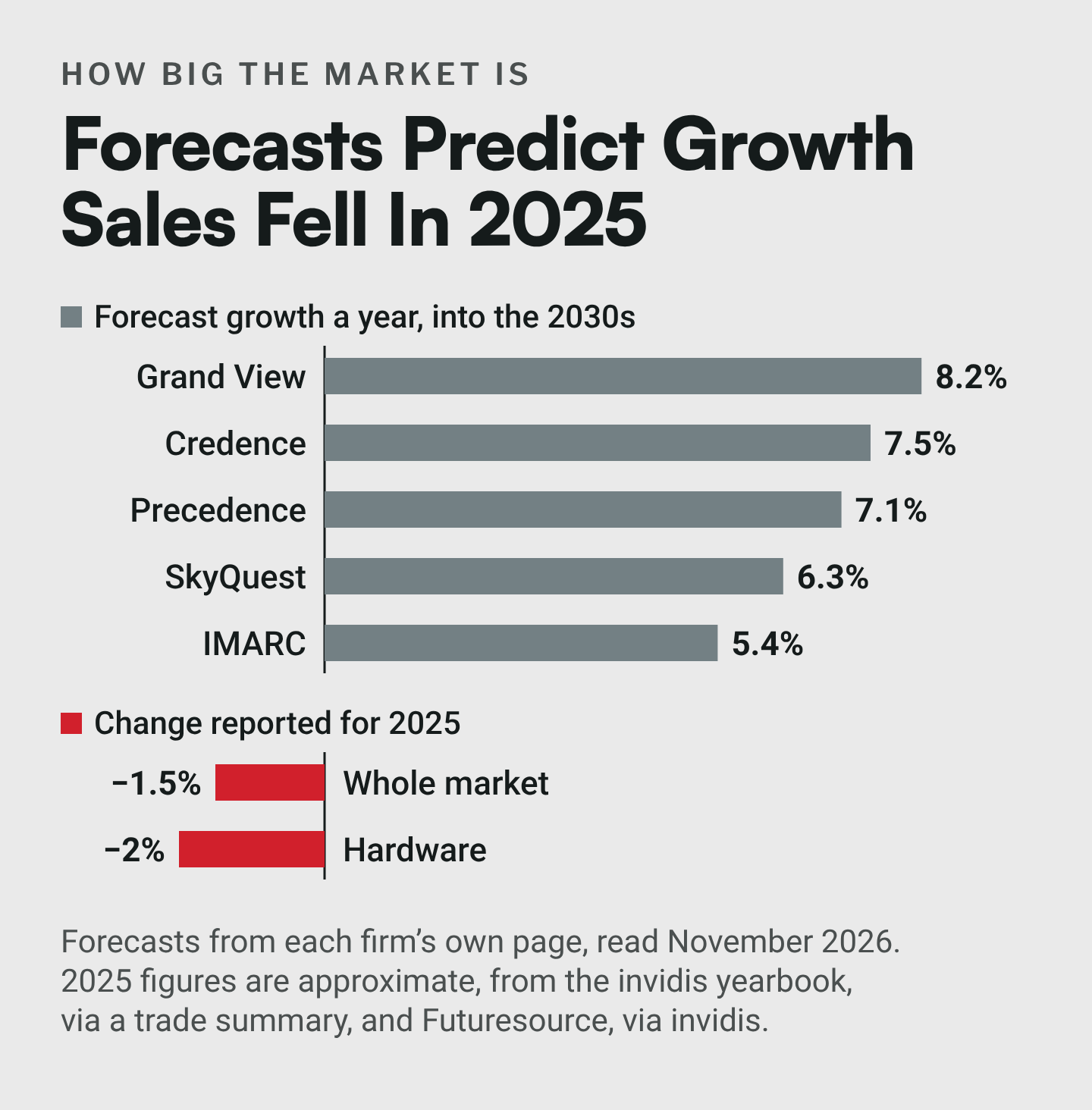
The five forecasts we checked for the whole digital signage market have it growing by between 5.4% and 8.2% a year into the 2030s. The firms that track sales report something else. At this year’s Digital Signage Summit Europe in Munich, the consultancy invidis presented Futuresource figures (opens in a new tab) showing that hardware sales worldwide fell by about 2% in 2025. Its own yearbook put the whole 2025 market at €20.6 billion, about 1.5% smaller than the year before. We have that figure second-hand, from a trade blog’s summary (opens in a new tab).
Both sets of numbers may well be right, since a forecast covers the years ahead and a sales count covers one year already past. A partner planning next year should still work from the second set. By partner we mean the integrators and resellers that sell and install signage, and the managed-service providers that run it. Screens are getting cheaper, while media players are getting more expensive and harder to quote. What growth there is comes from software and the services sold around it. A partner’s margin therefore depends less on the hardware it ships than on the platform it builds services on, and on who is accountable for keeping that platform running.
How big the market is
A partner’s revenue plan usually starts from someone’s growth rate, and the highest rate we found for the whole market is one and a half times the lowest. The table sets out the seven forecasts we could check against the firm’s own page in early November 2026. Five cover the whole market and one covers hardware, while the seventh is titled a software market though its page breaks the figure down by hardware and services as well as software.
| Firm | Covers | Starting value ($ billion) | End value ($ billion) | Stated growth a year |
|---|---|---|---|---|
| Grand View Research | Whole market | 31.1 in 2025 | 58.4 in 2033 | 8.2%, 2026 to 2033 |
| Credence Research | Whole market | 18.9 in 2023 | 36.3 in 2032 | 7.5%, 2024 to 2032 |
| Precedence Research | Whole market | 27.1 in 2025 | 57.7 in 2035 | 7.1%, 2026 to 2035 |
| SkyQuest | Whole market | 23.0 in 2024 | 39.8 in 2033 | 6.3%, 2026 to 2033 |
| IMARC Group | Whole market | 30.1 in 2025 | 49.4 in 2034 | 5.4%, 2026 to 2034 |
| Market.us | Hardware | 15.7 in 2024 | About 30 in 2034 | 6.8%, 2025 to 2034 |
| Research Nester | Software, by its title | 11.7 in 2025 | 39.8 in 2035 | 13%, 2026 to 2035 |
The firms sell the full reports, and the free pages give an outsider too little to reconcile them. The published numbers still show where some of the difference comes from. IMARC has the market adding about $19 billion between 2025 and 2034, and Grand View has it adding $27 billion between 2025 and 2033. Three of the firms that cover the whole market also publish a value for 2026. IMARC and Grand View both have the market growing by 8% in that one year, and Precedence, whose page gives $31.4 billion for 2026, has it growing by roughly 16%.
The firms that track sales describe a slower market. Both the 1.5% contraction and the 2% fall in hardware are for 2025, and AV News reported from the summit (opens in a new tab) that for invidis the year "was largely flat for the industry overall, particularly on the hardware side". In the EMEA region, the yearbook summary says, the market grew by about 2% in value that year while the world market shrank. The summary has American signage expanding by only 1% to 2%, against an economy it expects to grow by 2.1% to 2.3% in 2026. A plan built on growth of 7% or 8% a year relies on figures that these sales data do not support.
The explanations on offer concern supply and price. At the summit invidis said that Chinese manufacturers such as TCL, Hisense, and BOE "are becoming major market disruptors", and that LED prices were falling. The yearbook summary adds that manufacturers avoiding American tariffs sent Europe far more screens than it had demand for, which cut both margins and prices. One display maker has already withdrawn. Vestel, a Turkish electronics group, was reported in November 2025 (opens in a new tab) to be closing its own-brand professional display business while continuing to build screens for other brands, and among the reasons the report gave were competition from Chinese manufacturers and the market’s move to LED.
Which revenue is growing
If hardware revenue is flat, a partner needs to know which revenue is growing.
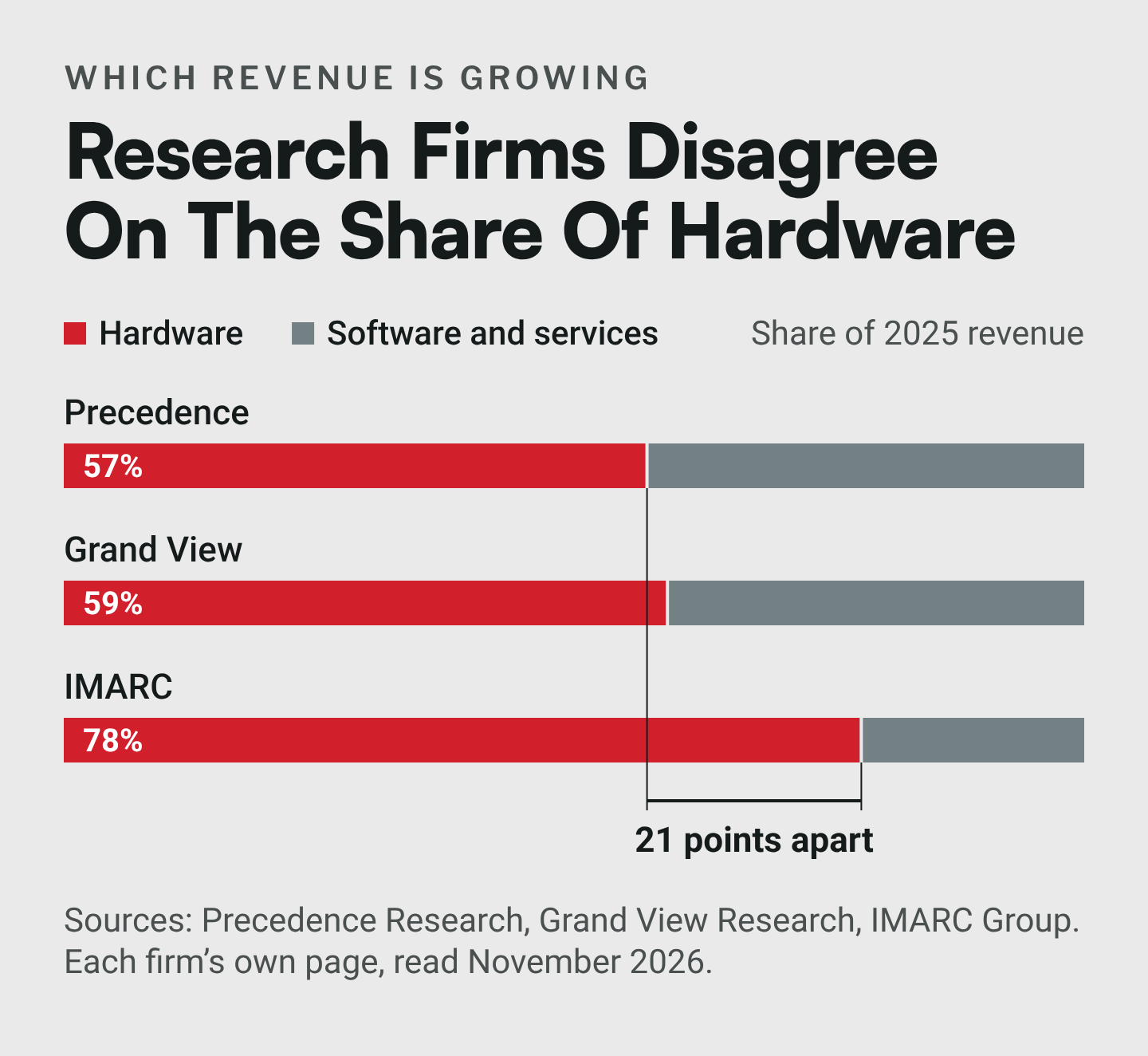
The research firms can’t agree on how much of the market is hardware. For 2025 Precedence says 57% of revenue, Grand View says 59%, and IMARC says 78%. Two of them publish growth by component, and neither has hardware growing fastest. IMARC has services growing fastest, at about 7.2% a year against 5.4% for the whole market, and Grand View has software growing fastest, at 8.5% against 8.2%. Research Nester’s software forecast is for 13% a year from $11.7 billion in 2025. At the summit invidis said that hardware was losing share and that growth now came from cloud platforms and managed services.
Who collects that revenue is changing as well. The yearbook summary describes a market moving from audiovisual specialists toward global IT managed-service providers, which have the scale and the balance sheets such contracts need. Under those contracts, it says, customers increasingly buy uptime and outcomes in place of screens, and the hardware remains the provider’s property, held as a service asset for five to ten years. In quick-service restaurants and hospitality, the summary adds, menu boards and order kiosks are already sold inside point-of-sale platforms for a monthly subscription.
Outside Europe and North America, integrators face a different set of rivals. In many of the less developed markets of Asia, Africa, and Latin America, invidis reported in August (opens in a new tab), screen makers such as Samsung and TCL sell complete packages straight to customers. Telecom operators typically hold the strongest customer relationships with small businesses, and office-equipment vendors such as Ricoh and Toshiba have built sizable signage businesses. Online retailers such as Amazon, which sells a signage stick of its own, have become large sellers of the cheapest systems.
The report calls the move to managed services "the most profound shift", with hardware increasingly remaining the provider’s property while customers buy access and uptime. Its conclusion fits the managed-service contracts described above as well as the markets it covers. The market, it says, "is not consolidating around fewer brands, but around fewer points of accountability".
The same reasoning applies to a partner’s own margin. A markup is a share of the panel’s price, so it falls each time the panel gets cheaper. A monthly fee for keeping a network running is tied to the work and not to the price of the panel, and it renews. The partner margin that lasts is therefore in scoping and content work, in monitoring, in support, and in running the network as a service. A customer will probably pay for that work only if it knows whom to hold accountable when a screen fails.
What changed in 2026
Much of what a partner must explain to a customer changed in 2026. Player prices rose, invidis argued that devices must be patched far more often, more vendors let an AI assistant administer the network, and retail media, meaning advertising sold on a retailer’s own screens, was again described as a boom.
Players cost more and quotes expire sooner
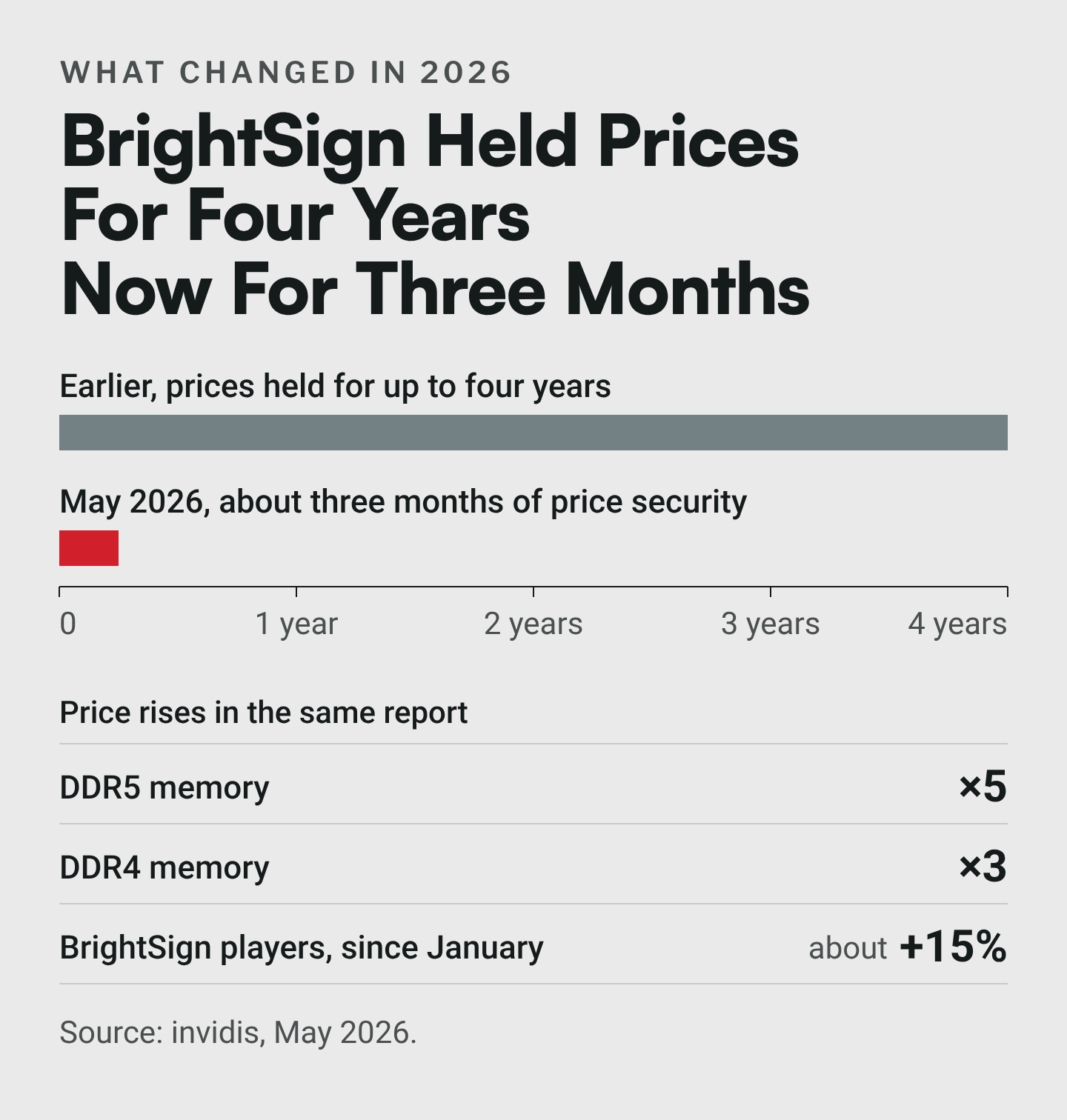
Memory is the cause. In May invidis reported (opens in a new tab) that the AI boom and geopolitical tensions were pushing up hardware prices, memory prices above all. DDR5 memory prices had risen fivefold and DDR4 prices had tripled. BrightSign’s player prices had risen by about 15% since the start of the year, and BrightSign players assembled in Vietnam had been "temporarily stuck in containers due to bottlenecks in the Middle East", though the report says they have since arrived. BrightSign once kept its prices stable for as long as four years. Marc Schiedl of BrightSign told invidis that the company could now offer customers "about three months of price security".
Prices of entry-level players have risen most, and mid-range players absorb the increase more easily, the report explains, because storage accounts for a smaller share of their price. Mike Finckh, managing director of the German distributor Concept International, said that in some cases prices may have doubled. Android players need less memory and storage and so remain relatively cost-efficient, and Concept International reports strong demand for Linux players on ARM chips. Embedded Windows players are "losing ground", the report says, because of their hardware requirements and the cost of an operating-system license.
Schiedl said he saw no move on price grounds from external players to displays with a built-in processor, which is what a maker of external players would say. He did report projects being delayed or scaled down.
For a partner, a quote that names a player model might hold only as long as its maker’s prices do, which for BrightSign is now about three months. Software that runs on several kinds of player lets the partner substitute one when another is unavailable or has become too expensive.
Who patches, and where the data is held
Strong security is now a minimum requirement and no longer a differentiator, in the view the summary attributes to the yearbook’s editors. At the summit invidis argued that updating devices every 18 to 24 months no longer matches the threat. It pointed to Microsoft’s device platform, MDEP, whose quarterly security updates it called the new benchmark, and to Anthropic’s Mythos as a demonstration that AI can find operating-system vulnerabilities automatically. The yearbook summary says that AI has made attacks faster and cheaper and is forcing the industry to patch in months where it once took years.
The summary adds that origin "starts to matter", by which it means that buyers increasingly ask where software is developed and governed as well as where hardware is made. In a passage on tariffs and trade tensions, invidis also said at the summit that wariness of American vendors is growing in Europe.
A partner should be able to say who applies patches and how fast, and where the data is held. The answers depend on who hosts the platform. In a vendor’s cloud, whether shared or dedicated to one customer, the vendor patches and operates. In the customer’s own cloud account or datacenter, or on a network with no internet connection, that work passes to whoever runs the system. A partner that offers hosting takes on the cluster, the databases, the backups, and the recovery tests, which makes hosting a line of business only for a partner that can staff it.
AI is now used to run the network
Some vendors now let an AI assistant administer a signage network. They do so through the Model Context Protocol, or MCP, an open standard that Anthropic introduced in 2024 and that lets an assistant call a software system’s functions through one common interface. A vendor that publishes an MCP server lets an administrator type an instruction and have the assistant carry it out. Revel Digital, a signage software vendor, announced a preview (opens in a new tab) of its server in August 2025, with examples such as "Show me all my online devices and their current status".
We found no complete count of the vendors that support MCP. The fullest list we found is kept by CastHub (opens in a new tab), itself a vendor, which counts three vendors with production servers, itself among them, and a few more in beta. It places Korbyt on the roadmap, where Korbyt’s own page (opens in a new tab) shows a target of December 31, and it does not mention Wallboard, whose MCP connection was announced as a beta in March. Treat any vendor’s list as incomplete.
A partner should sell AI administration with care. Revel’s announcement warns that "AI can and will interpret your requests in sometimes unexpected ways", up to moving or deleting devices and media, and it recommends restricting the API role the assistant uses to read-only unless updates or deletions are intended. What can fairly be sold is hours saved on named administrative tasks, by an assistant that signs in as a named user and holds only that user’s permissions.
Advertising on screens is a media business
AV News reported (opens in a new tab) that retail media "was repeatedly described as a continuing boom area" at the summit, one that is "here to stay". The question for a partner is whether advertising revenue can cover the cost of the screens.
Some networks probably can, but a partner should check what the evidence measures. In a 2024 Harris Poll survey of American adults for the Out of Home Advertising Association of America (opens in a new tab), 76% of people who had recently seen a digital out-of-home ad said they had taken some action because of one. The association’s definition of out-of-home media takes in billboards and street furniture, transit and place-based media, so the figure is not about screens in stores alone. The survey was run for the industry’s own trade association, and it records what respondents said they did.
An advertising network also needs advertisers and people to sell them the space, and it needs proof that the ads played. Connecting the software to an exchange that sells the screen time is the easy part.
Who bought whom, and what vendors charge
The vendors a partner sells, or competes with, are changing owners, and with new owners come new terms for partners.
The deals
| Announced | Buyer | Bought | What was said |
|---|---|---|---|
| July 2024 | Wallboard, United States | Keywest Technology and Unified Brand, United States | Developers and a managed content service joined Wallboard |
| July 2024 | Playipp, Sweden | Databeat, Norway | Backed by the investor Monterro |
| August 2025 | Navori Labs, Switzerland | Signagelive, Britain | Navori called the result the largest independent, channel-only CMS provider by installed base |
| May 2026 | Vertiseit, Sweden | Scala, from Stratacache | About SEK 265 million, completed June 1 |
| August 2026 | Uniguest, United States | Visix, United States | Terms not disclosed |
| September 2026 | Playipp, Sweden | NDS, the Dutch-French maker of PADS4 | Price not stated |
The Scala sale changes the terms for partners. Vertiseit paid about SEK 265 million for a business that it said would add roughly SEK 85 million of recurring revenue, and Scala came with more than 1,000 customer brands and a network of more than 100 partners. In September Vertiseit announced that Dise (opens in a new tab), its partner-only subsidiary, would become Scala. Scala will be sold "exclusively through selected and certified Scala partners", the announcement said, and customers and partners can expect "continuity in their relationships, mutual commitments and support". Vertiseit’s second-quarter report (opens in a new tab) put acquisition and integration costs at about SEK 28.6 million.
At least one rival is advertising to Scala’s customers in the meantime. Korbyt offers migrations (opens in a new tab) that it says are typically complete in under 90 days, on a page that also notes that no mandatory migration has been announced.
Stratacache, the seller, had a hard year. It had owned Scala since 2016, and the sale was announced in the month that its British companies went into liquidation (opens in a new tab). In Britain it had recently put a retail media network into 766 Iceland Foods stores, and through a subsidiary it had enabled another across nearly 300 Currys stores. Later in May it sold its campus in Trotwood, Ohio (opens in a new tab), where signage hardware was assembled and in which its founder had invested about $30 million, to a real estate developer for $18 million.
These are not small vendors. By active licenses, the 2025 ranking from invidis (opens in a new tab) put Stratacache and Samsung at the top, with more than a million each. Uniguest, Navori Labs, and Poppulo followed with more than half a million each. Of those five, Stratacache has since sold a signage business, and Uniguest and Navori have each bought another vendor.
How to measure a return
Customers ask a partner what the screens will earn, and the reply is often a list of statistics. A calculation the customer can check serves better.
For a network meant to sell more, the return on investment is the extra gross margin plus the running costs saved, less the cost of the program, divided by the cost of the program.
ROI (%) = (extra gross margin + operating savings − program cost) ÷ program cost × 100
Measure every term over the same period, such as the contract’s length. Use margin and not revenue, because extra sales are worth only the profit they leave after the cost of the goods. The program cost covers the displays, the players, the software licenses, the installation, and the labor of keeping content current.
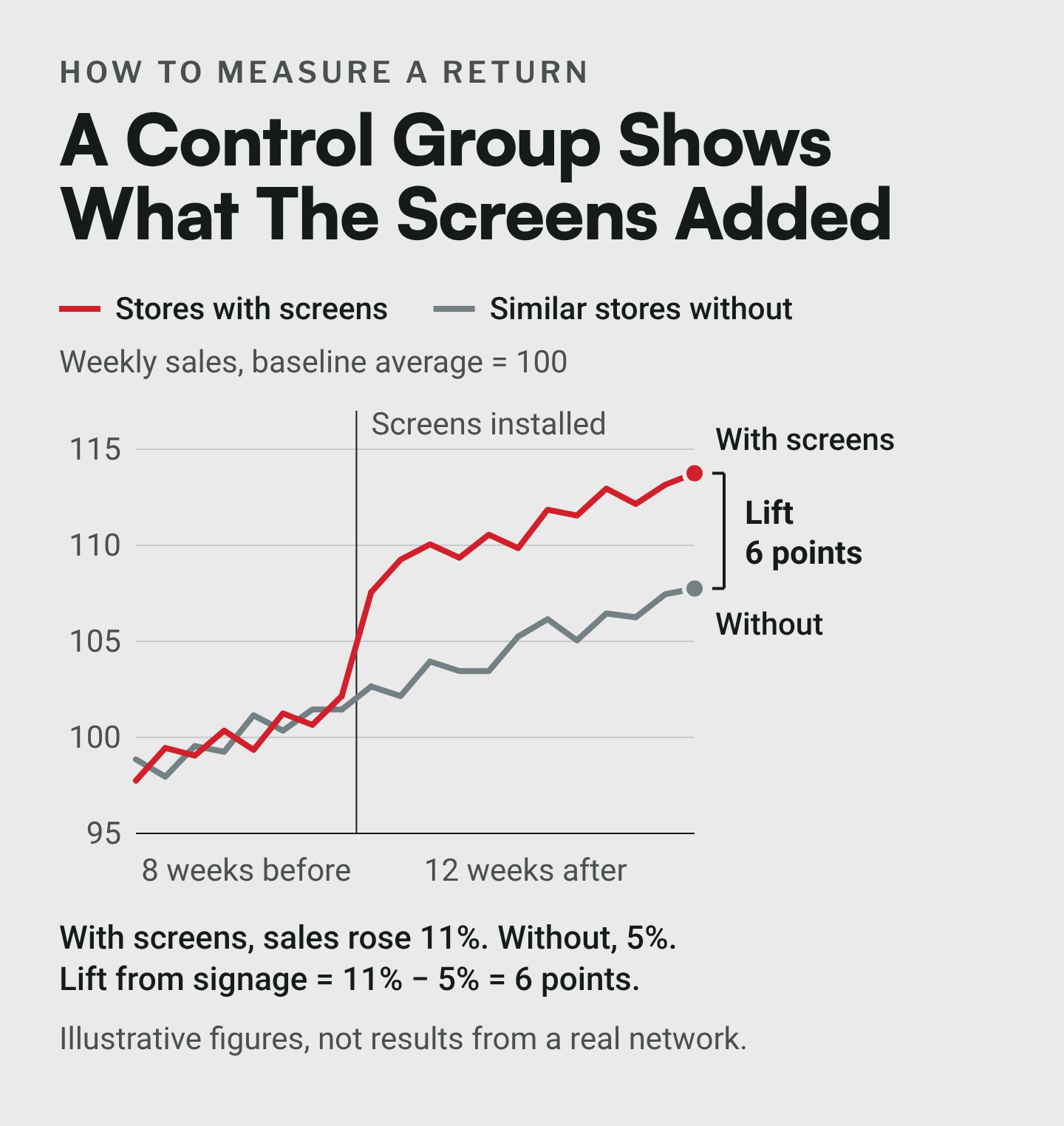
To separate what the screens did from the season and the economy, compare stores that received screens with similar stores that did not, over the same weeks, against a baseline measured for several weeks before installation.
Lift from signage = (test stores after − test stores before) ÷ test stores before
− (control stores after − control stores before) ÷ control stores before
The best published evidence we found of what to expect is a 2026 study in the Journal of Marketing (opens in a new tab) covering 237 advertising campaigns and 30 million shoppers. Digital signage raised the likelihood of buying a featured product by 8.1%. The effect was larger when the screen stood near the product and when no other promotion was running, and people who bought did not spend more. Older studies measured attention and waiting. A 2010 Intel study (opens in a new tab), reported in a brief for Intel’s audience-measurement software, found that digital signs drew "more than 400 percent more views" than a static sign. A study of a tram line in The Hague (opens in a new tab) found that real-time information displays at stops cut perceived waiting time by 20%.
Many of the figures that vendors quote are weaker. The claim that eight in ten customers enter a store because of a digital sign comes from a 2012 FedEx Office survey (opens in a new tab) about business signs in general, in which the figure was 76%. An 83% recall rate for digital signage matches a figure in a 2008 Arbitron study (opens in a new tab) for the outdoor advertising association, where it was the share of people who had noticed seven roadside billboards in Cleveland and could recall at least one advertisement. A vendor statistics page (opens in a new tab) that carries many such figures says of itself that "numbers without a citation are editorial estimates". Both figures have appeared on our own blog, the second credited there to a 2015 study by the same association.
A partner that measures the customer’s own stores, with a baseline and a control group, gives the customer a number its finance team can check.
What Wallboard offers
Everything above applies whichever platform a partner sells. What follows is about ours, and every claim in it is already public, whether on our website, in the trade press, or in the public editions of our technical documents, which partners can ask us for.
Wallboard is an enterprise digital signage platform that started in 2012 (opens in a new tab), with sales and marketing run from Dallas and its technology team in Hungary. In 2024 we acquired Keywest Technology and Unified Brand, which brought us more developers and a managed content service.
Version 2.1, announced in March 2026, makes playlists and slides the main way to build most content. A slide is a branded template designed once, so that other users can safely edit only the parts they need.
The release also upgraded the internal data sources that supply live content. A user can now send a link that lets someone with no Wallboard account, a restaurant manager for example, update the data that the screens display in a spreadsheet-like view, with rows and structure locked against accidental changes. An AI web scraper takes a plain-language description of what the user wants from a web page, and AI-generated data sources search the web and turn what they find into data for the screens.
Player software is available for Android, Windows, BrightSign, LG webOS, Samsung Tizen, and ChromeOS, with a browser client for other devices, which gives a partner more than one kind of player to quote. The platform also supports e-paper displays from Philips and Sharp.
The platform runs in our cloud, shared or dedicated to one customer, or on a system that the customer hosts in its own cloud account or datacenter. Customer-hosted systems can run on a connected or a restricted network, or on one with no outside connection at all, which takes its updates as offline packages. The application is the same in each case, and what differs is who operates it and which functions that depend on internet services an isolated site can use.
Wallboard has successfully completed a SOC 2 Type II examination for Security, with no exceptions noted. The report is available under a confidentiality agreement.
In our cloud, data is encrypted in transit and at rest, and customer data hosted in the EU region is stored in the EU or EEA and is not replicated to the American region. Independent firms test the system for weaknesses each year. Version 2.1 added self-service single sign-on through SAML 2.0 and passwordless login, and it lets an organization require multi-factor authentication of all its users.
The same release added an MCP connection, labeled a beta, that lets a user run the platform from an AI assistant such as Claude or ChatGPT, with sign-in through OAuth. invidis reported at launch (opens in a new tab) that more than 740 platform functions could be managed that way. One of our worked examples sets up a company’s whole portal, with its teams, permissions, single sign-on, and 25 registered screens, in one prompt in place of two to three hours of manual configuration. The page gives no measurement behind that figure.
The integrations page names 40 connections, among them Toast, SharePoint, Power BI, and alerting systems that use the Common Alerting Protocol, and other systems connect through APIs and webhooks. One of the 40 is Vistar Media, through which advertising time on screens is sold. That connection, as we said above, is the easy part of an advertising business.
Conclusion
The forecasts we began with have the market growing by between 5.4% and 8.2% a year, and the firms that track sales have it about 1.5% smaller in 2025. Both may be right. We have the second figure only second-hand, from a summary of the invidis yearbook, and we have still preferred it, because it describes a year already past and a partner’s next year starts from there.
That year shows where the margin is moving. Screens are getting cheaper, so a markup on the panel shrinks with them. The revenue that renews is paid for keeping a network running, and a customer pays it when it knows whom to hold accountable. Each change of 2026 added to that work. A player quote that once held for as long as four years may now hold for about three months. Devices are expected to be patched in months, not years. An AI assistant can administer a network, and can also move or delete what nobody meant it to touch. An advertising network needs advertisers, people to sell them the space, and proof that the ads played. Somebody has to own each of these, and a partner that builds services on a platform owns whatever part of them the platform leaves undone.
A partner should therefore be able to say four things about any platform before building services on it, and to say them from evidence it can check. The first is which kinds of player the software runs on, because a quote tied to one maker lasts only as long as that maker’s prices. The second is who applies patches and how fast, and where the data is held, under each way the platform can be hosted. The third is what an AI assistant can do through the platform, and whether it signs in as a named user with only that user’s permissions. The fourth is what the platform costs, from a published price where there is one, and what a license meters besides screens. A platform whose vendor cannot answer these leaves the partner accountable for work it cannot see.
The same test applies to what a vendor says the screens will earn. Many of the statistics that vendors quote turn out to describe something else, such as business signs in general or roadside billboards in Cleveland. A lift measured in the customer’s own stores, against a baseline and a control group, is worth more to its finance team than any of them.